
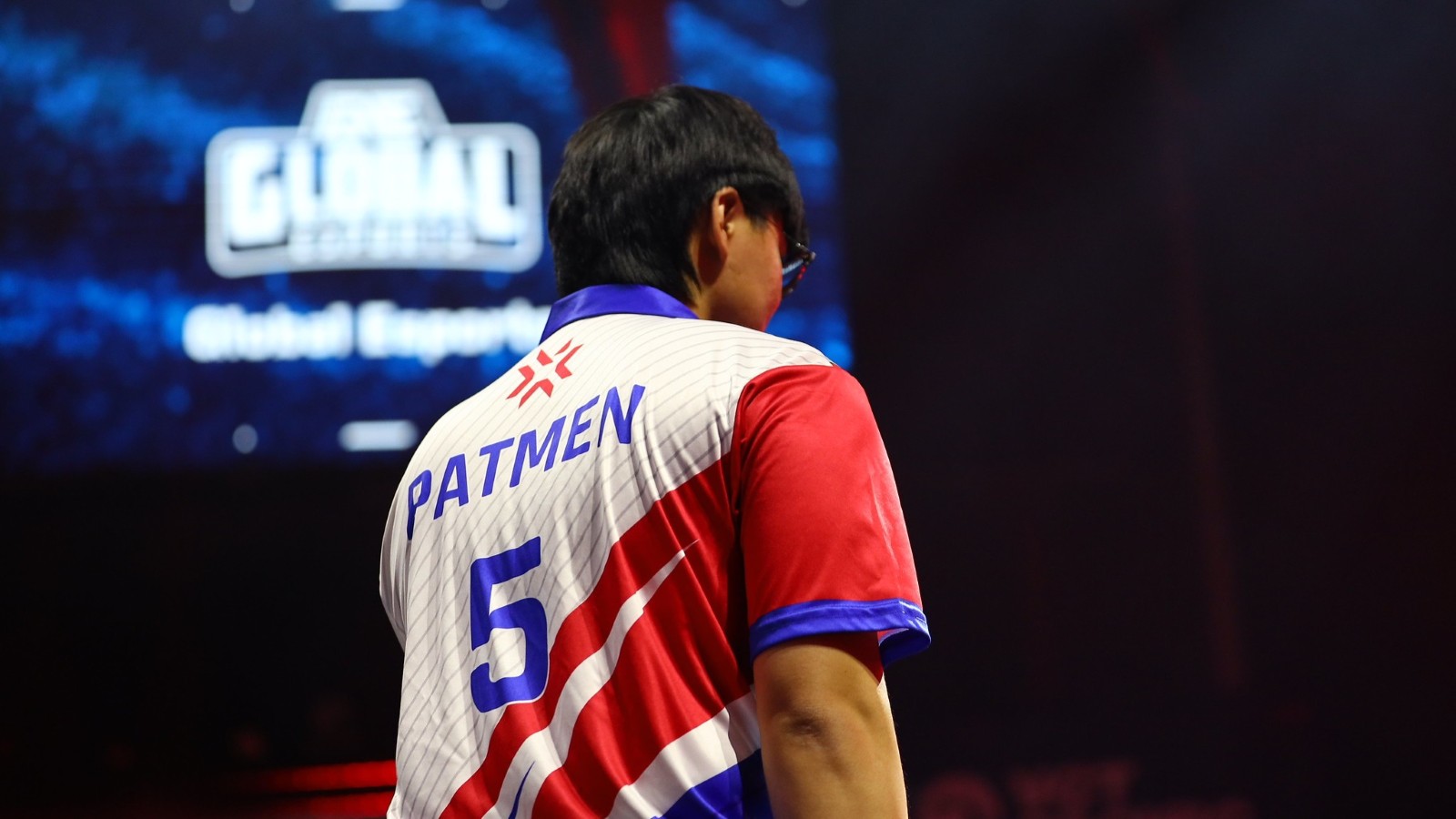
Earlier in VCT Pacific Kickoff 2026, Patmen pulled off one of the craziest VCT performances of all time, dropping 32 kills and 5 deaths on Breeze. Consequently, he had a 2.81 rating, which was (and is) the highest map rating of ALL TIME. Even crazier? Global Esports lost that match 1-2. Even crazier? They lost that match to DFM (the only team to end an entire VCT season without a single series win). Even crazier? He was playing OMEN. Even crazier? He didn’t fist fight each and every one of his teammates (well, as far as we know).
It seems clear that Patmen is better than the mediocrity that is Global Esports. However, it makes it even weirder to flash back to 6 months ago, when Patmen was dropped by PRX for being the weak link in that juggernaut of a team. The two realities seem contradictory. Can Patmen really exist in this void where he underperforms on the best teams, but he overperforms on the mediocre teams? However, in order to answer that question, we have to answer the question: what does it even mean to be an over/underperformer in VCT?
Tuning the Definition
Despite its detractions, the holistic approach underpinning VLR’s rating system gives us as close to a good measure of player performance as we’ve seen. Beyond just looking at simple (but important) numbers like kills and deaths, it weights kills based on the player count and the duel’s subsequent weight on the round win percentage, accounts for economic differences between teams, looks at trades/tradability, and incorporates assists. For more details, you can read more about VLR rating here. At the end of the day, it emphasizes the basic yet important statistics while remaining wise to the fact that all kills and deaths are not made equal. Of course, there are still intangibles such as IGLing, midrounding, or “vibes” that have a real impact on the game, but I’m yet to see a statistic that incorporates this as well. This is all to say that VLR rating will be my response variable for this article’s sake.
Next, I want to call back to a point I made in my sympathy rant for Patmen; he was playing Omen when he dropped that supercalifragilisticexpialidocious statline. For those who don’t know much about Valorant or are ridiculously casual, Omen is a Controller (one of the four agent classes in this game), which means that his arsenal is centered around casting smokes for his team and other strategic/movement abilities (rather than offensive ones). This is noteworthy because that would, presumably, make it harder to rack up such a high rating on a passive and selfless role. Well, let’s check if this initial presumption is even true by looking at the average VLR rating by role across all regions in 2026 Kickoff.
As you can see, there is a marginal, but notable difference in VLR rating by agent role. Surprisingly, it was the Sentinel role that had the highest rating. I postulate that Duelists are often dying first too frequently on site executes, Controllers and Initiators are forced to play with the pack, while Sentinels are fully able to both lurk and bait in whatever way suits their personal performance, but I digress. The important result here is the obvious difference by role (and for those who don’t know, 0.03 is a non-negligible difference between rating averages by role).
All that being said about roles, the larger point about Patmen was that his team wasn’t winning at the rate you’d expect from a player posting numbers like that irrespective of the role he was playing. Player rating and team success usually (and should) move together in Valorant. The theory here is that, when there’s a wide gap between a player’s rating and his team’s round win %, it’s a pretty clean signal that he’s either hard carrying or getting hard carried. Let’s see how this shakes out across Kickoff 2026 with a scatterplot of player VLR rating against round win %.
So many fun observations to be had! First off, my initial assumption was true — there’s a clear positive linear relationship between winning at a higher rate and higher VLR ratings, though any other result would be befuddling. Honestly, it’s surprising that the trend isn’t even more drastic. There are a decent number of players on the winning end of teams with sub-1.0 ratings (I’m looking at you Jawgemo), though the majority are healthily above 1. While we’ll discuss this more explicitly later, you can hover your mouse over some of the notable datapoints in the top left/bottom right to see some of the biggest over/underperformers. Poor Lukxo, sitting there with a 1.13 rating at the lowest end of the Round Win % axis, a higher rating than any player on NS (the highest Round Win % team). At least he got this clip:
Mapping the Definition
Now, what if we synthesize these two ideas: using roles and a team’s round win % to observe trends in player performance? To do this, let’s look at individual scatterplots, grouped by roles.
A quick clarification of the methodology:
- To determine a player’s “role”, I looked at their proportional breakdown of agent play counts in a given event and then assigned them to whichever role they played on a majority (≥50%) of their maps. In the case where there is no simple majority, as multiple roles occupy large proportions, they are classified as “Flex” and shown in a fifth chart. Additionally, as players are analyzed on a per-event basis, it’s possible for a player to show up in multiple scatterplots if they switched roles.
- These graphs only use regional data, as international events introduce noise from varying competitiveness by region. Furthermore, they will skew the strongest teams’ numbers downward, since making a deep run at an international means you play the best teams from every other region. Meanwhile, in regional play, every team plays through a designated schedule, so a top team’s round win % is buoyed by equal-level matchups.
These graphs are treasure troves for highlights (and lowlights) of player performances throughout VCT history. But first, the important things to note:
- The main trend continues of a strong positive linear relationship between round win % and individual ratings. Just as before, different roles operate at different baseline rating scores and thus different expectations for what is “overperforming” and “underperforming.” Perhaps more interesting (and likely to come up later) is the fact that the slopes seem to be slightly different. For instance, the increase in ratings for the Duelist class is noticeably steeper than the Sentinel class. The implication here seems to be that a Duelist’s individual performance is more closely bound by their team’s performance than a Sentinel’s, who has more skill expression allowed irrespective of team performance. Still, the positive correlation exists in both cases. Interesting!
- The scatterplots are clearly informative in the context of VCT. Players in the top-left quadrant of these scatterplots are players who are outperforming their team and deserve better. For instance, look at Invy’s 2025 Stage 1 performance, where the scatterplot makes it obvious he has the pedigree to be a great player on a great team (hopefully one with a round win % higher than 45.8%). In fact, we now know this to be true, as he got scouted to PRX and led them to a second-place finish at Masters Santiago. In this same school of thought, it allows us to find other pros with hidden potential. For instance, a player like UdoTan wouldn’t stand out to you if you looked at VLR ratings in Pacific Stage 1; 1.04 is only moderately above average. However, given his team’s horrendous performance, we know his rating is much more impressive than it may initially seem. Again, the scatterplots work.
As for some personal thoughts, these graphs remind me of some of the notable individual forms we’ve seen in VCT history. Trent’s form in 2025 is something people seem to have moved past (probably because they choked at every international), but his datapoints for Kickoff and Stage 1 are reminders of not only how insanely good he was, but how good he was even for a team that was as domestically dominant as G2 in 2025. People forget that he was in discussion for the greatest player in the world throughout 2025. What’s more, he managed to put up those numbers without acing a single time in 2025 (weird but true).
On the opposite end of the spectrum, if you go to the Controller scatterplot and just look at the lowest data points for high round win %, they’re all Boaster. That checks out. However, this is a good reminder that these graphs are not gospel. Boaster is the backbone of Fnatic and does more for that organization’s success than statistics will ever be able to show.
Lastly, it seems like Gen.G were pretty warranted in dropping Suggest. There are more and more little anecdotes hidden amongst these scatterplots, but I’ll leave that to you if you want to look around.
Putting It All Together
Finally, let’s create a simple model that uses round win % relative to the role played to predict the expected VLR rating from a VCT pro.
| Role | Intercept (α) | Slope (β) |
|---|
Adding an interaction effect between role and round win % reveals that among the four main roles, Duelist has the strongest positive relationship with round win % (β ≈ 0.12) and Sentinel the weakest (β ≈ 0.10), confirming my earlier observation.
By looking at residuals (the difference between expected and true rating), we can get an initial sense for who the greatest over/underperformers are of both all-time and the current era!
Preliminary Greatest Over/Underperformers of All Time
Note: This model is not final, and thus neither are these rankings. The final rankings are further down.
| Player | Rating | Expected | Residual | Std. Devs. |
|---|
| Player | Rating | Expected | Residual | Std. Devs. |
|---|
For the Current Era (Kickoff 2026)
| Player | Rating | Expected | Residual | Std. Devs. |
|---|
| Player | Rating | Expected | Residual | Std. Devs. |
|---|
Awesome! Some quick thoughts:
- No Patmen in the top 10 overperformers of this Kickoff. Maybe I overreacted on his behalf.
- Every single member of the top 10 underperformers of all time is no longer in VCT, except for Derke (which makes sense as an all-time great) and Crws (who proceeded to get dropped and then, just recently, get picked back up by Full Sense). This initial analysis has some merit.
- 2 of the 3 greatest “overperformers” of all time came from this most recent Kickoff — Johnqt and Hiro. Perhaps we should be more grateful for the quality of players that we’re currently witnessing. I can’t speak so much for Hiro as I didn’t closely follow EMEA this Kickoff, but Johnqt did have a ridiculously good Kickoff. However, he was also accused of baiting and statfarming this Kickoff (hence the nickname JohnKD), which would potentially skew the validity of using rating as our outcome variable.
The Baiting Problem
This is a genuine concern — if baiting inflates a player’s rating beyond their actual contribution to the team, our model is rewarding them for it. What if we removed all players who had the lowest FDPR (First Deaths Per Round) on their team as a way of filtering out baiters? Let’s see:
| Player | Rating | Expected | Residual | Std. Devs. |
|---|
Aaaaaaaaand there go Johnqt and Hiro. However, this feels a bit crude. I have no doubt that Hiro and Johnqt baited in order to get the statistics they got, but I also have no doubt that they still performed well even after accounting for their baiting. But how do you account for their baiting? I could just add FDPR into the model, but that comes with problems. Better teams will have fewer first deaths, so just plugging in this variable would be unwise; it’s not a “fair” variable per se. There’s a difference between Zekken and Cauanzin having 0.11 FDPR in 2026 Kickoff (namely that Zekken is a selfless player who is just on a good team while Cauanzin is a massive baiter who’s on a bad team).
After thinking through this problem, I came to a solution — create a new variable that is the proportion of a player’s deaths relative to their team’s total deaths, namely:
Using this, we can identify “baiting” while being fair to players on better teams. The name of this new variable, PTD, means Proportion of Team’s Deaths.
As a sanity check to make sure PTD was calculated correctly, let’s see if the PTDs for a given team add up to 100. Pun intended, here’s 100 Thieves:
| Player | Rating | PTD |
|---|
Checks out! Before moving on, let’s see who the biggest baiters (lowest PTDs) of all time are:
| Player | Org | Event | Rating | PTD |
|---|
Seems like we can move past “accused of baiting” and just say “baiting” for Johnqt.
Final PTD Model
Now, let’s add PTD as a variable to the model, which makes it now look like:
With this new model, let’s look again at the greatest over/underperformers of all time.
Updated Greatest Over/Underperformers of All Time
| Player | Rating | Expected | Residual | Std. Devs. | PTD |
|---|
| Player | Rating | Expected | Residual | Std. Devs. | PTD |
|---|
For the Current Era (Kickoff 2026)
| Player | Rating | Expected | Residual | Std. Devs. | PTD |
|---|
| Player | Rating | Expected | Residual | Std. Devs. | PTD |
|---|
After all that work, we finally have a model that accounts for team performance, propensity to bait, and role played to see which players have vastly overperformed their team in a meaningful manner (re: accounting for baiting). Again, I find this fascinating. With these being my final findings, I have final thoughts:
- Congratulations to Oxy for winning my award for greatest overperformance of all time! I can’t say I disagree with the model’s assessment either. Oxy was incurring 23% of his team’s deaths (a ridiculously high rate) when the team was composed of…
- Runi (no longer in VCT)
- Moose (no longer in VCT)
- Vanity (no longer in VCT)
- Xeppaa (infamous paycheck stealer — for those who don’t know, he’s just straight up bad)
Oxy — PTD vs. Every Domestic VCT Player in History
In fact, Oxy was taking more deaths for his team than 99.2% of players in domestic VCT history. Amidst playing this selflessly for teammates that we now know were middling (at best), he still managed to put up a 1.24 rating on a team that got bounced in the first round of Stage 1 playoffs. - Florescent’s 2025 Kickoff being in the top 10 greatest overperformances of all time is the kind of fascinating result that I hoped to discover. What’s more, I appreciate this result because I’ve been a strong believer that Florescent has what it takes to not just be a great player, but a top-10 player in VCT. In fact, back in 2024, I predicted that Florescent would be a top 5 player in EMEA. Can I say I’m right now? Probably not.
In any case, the model’s result is a reminder of the squandered potential she consistently showed throughout the event. For instance:The eye test is certainly passed. Recall that Florescent concluded 2025 EMEA Kickoff with a 1.17 rating (third-highest at the event) on a team that finished DEAD LAST, all while tanking an above-average amount of her team’s deaths. A historically great performance on a historically horrible team.
- Ironically, Aspas went from appearing twice in the “Greatest Overperformers of All Time” list to zero times after accounting for baiting. I’m not saying anything, just noticing.
- Earlier, I wrote that “I have no doubt that Hiro and Johnqt baited in order to get the statistics they got, but I also have no doubt that they still performed well even after accounting for their baiting.” My new model affirms this. Johnqt’s expected rating went from 0.96 to 1.01 while Hiro’s went from 0.95 to 1.06. While it’s clear neither of these performances was historically great enough to be in the top 10 for all time, they both still make the top 10 for Kickoff 2026. I’m happy with this result, and it’s as things should be. Overperformers are those who play better than their team while playing with them, not those who bait because their teams are subpar. Johnqt and Hiro are two great players who had great Kickoff performances, but it’s less surprising when you consider the rate at which they were saving.
- Suggest may have had a 0.66 rating, but at least he wasn’t baiting!
- Now, 9 (not 8) of the players in the all-time underperformers list are no longer in VCT. Even better!
- Based on the fact that the overperformers lists aren’t just occupied with high PTD players and the inverse for the underperformers lists, this model seems fairly calibrated.
- If I’m a team wanting to make changes, I’d be looking at players like Seven or al0rante. Players like Primmie, Karon, and Lukxo are insane, but everyone already knows that.
- Based on this list for Kickoff 2026, I’ll predict that at least 3 of C1ndeR, Okeanos, Eggster, and GLYPH will be dropped by the end of the year. The rest have already been dropped (thyy, d3mur, UNFAKE, and baha) or have too much historical credit (Boaster and Jawgemo).
Conclusion
Finally, we’ve answered many questions: how do we understand being an “overperformer” or “underperformer”? Who are the greatest over/underperformers of all time? What about in current times? Yet, one question remains:
How much is Patmen truly “better than the mediocrity that is Global Esports”?
| Player | Rating | Expected | Residual | Std. Devs. | PTD |
|---|
He’s performing over a full standard-deviation’s worth better than we’d expect from a controller player on that Global Esports team. Also, he’s doing it without baiting. It’s not egregious, but he’s certainly better than his team. No fist fighting is necessary, though.
As a final gift, I’ll leave an interactive version of this model to mess around with. Input values for a prospective VCT player and the model will give you their expected rating as well as the closest comparison we’ve seen domestically.
| Closest Match | Org | Event | True Win% | True PTD | True Rating |
|---|