Championship DNA: Historical Trends To Note For Champions
Bobo — September 7, 2026
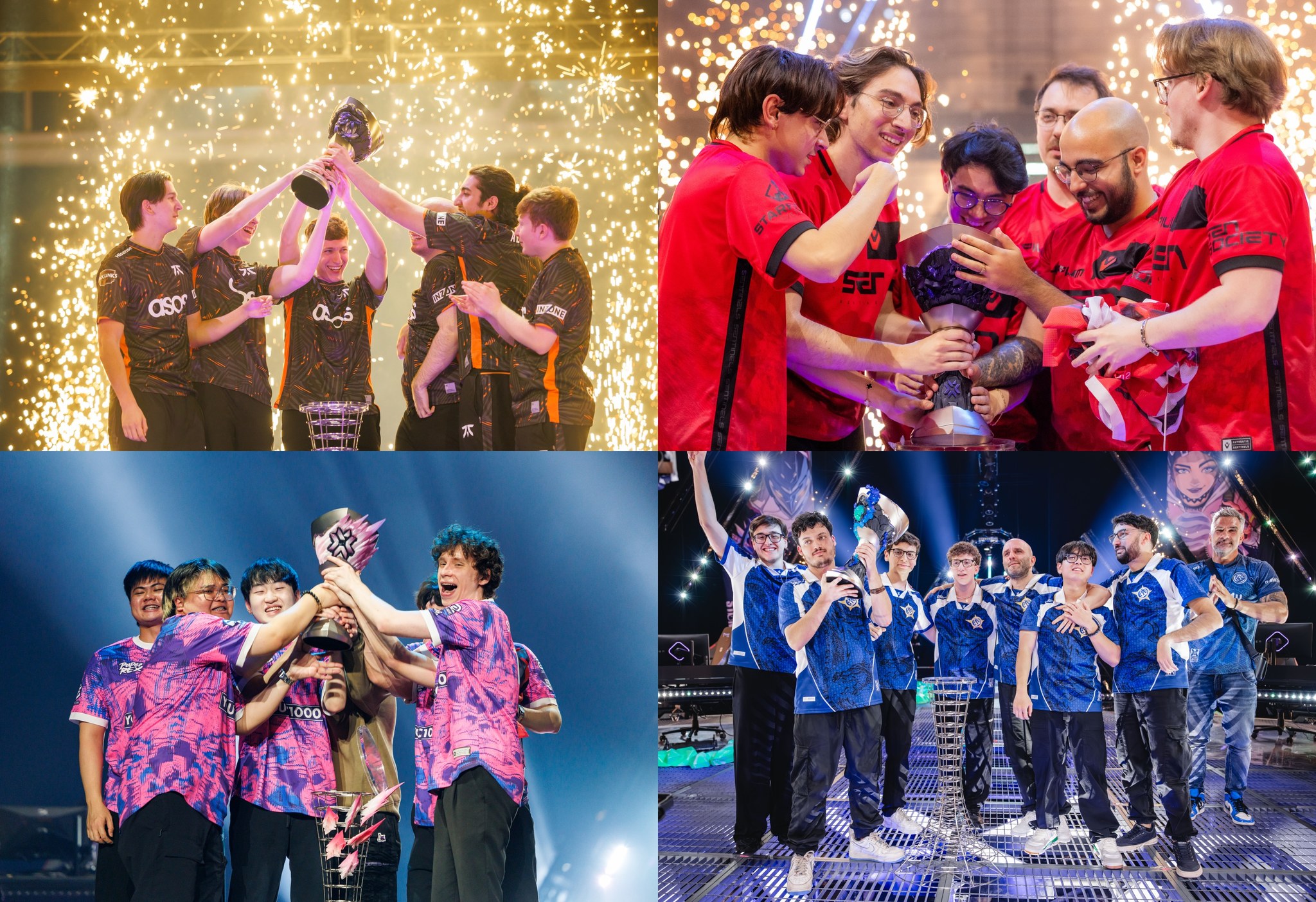
International winners from each year of franchised VCT FNATIC at Tokyo in 2023, Sentinels at Madrid in 2024, Paper Rex in 2025, and Leviatán at London in 2026
With Champions Shanghai right around the corner, the VCT fanbase will be making Pick’Ems, discussing their predictions online, casting bets, and constructing fantasy teams. With all 16 teams set alongside a large, captive, and opinionated audience, there is no better time to look back on the 4 years of franchised VCT history. How can we use history to sort through these teams and see who is expected to fail and who are the true favorites?
This tradition of studying historical trends exists heavily in other sports and the results are often fascinating (and accurate). I am excited to borrow these ideas, frameworks, and visualizations I’ve read over the years and bring them into the world of VCT. In this article, you will likely see a few references to college basketball/baseball analytics, so bear with me if that’s unfamiliar (or you can skip them).
The Winners: By The Numbers
One of the simplest ways that a championship team is understood in any sport is through their offensive and defensive strength levels. Rely too heavily on one of these sides, and imbalance can often lead to failure. VCT is no different, except we’re dealing with attack and defense rather than offense and defense. Here is a graph of every international-attending team in franchised VCT history, mapped by their attack win% and defense win% in the split prior. (e.g. Leviatán at Masters London uses their numbers from Stage 1 of 2026)
Trophy winners are automatically highlighted, but you can turn that off with the “Highlight Winners” button, allowing you to see/interact with all international-attending teams.
Note: Champions 2023 was not included, since there was no domestic split prior to the tournament
This is an awesome visualization that's fun to play around with! Some notes:
We can observe teams that did worse than they were expected to. For example, LOUD at Tokyo. This is a favorite example of mine, with a great narrative. 2023 LOUD were an amazing team with success before Masters Tokyo (2nd at LOCK//IN and then won Americas Stage 1) and after Masters Tokyo (3rd at Champions LA). They were a consensus top-2 favorite to win the event (Platchat put them above FNATIC, in fact, as favorites for Masters Tokyo). Thus, their flop at Tokyo was shocking and historic - what happened? As I recall, Masters Tokyo was the start of a rift between Less/Saadhak and Aspas, and these chemistry issues were only exacerbated by immediately playing (and losing to) EG, who went on to be runner-ups at the tournament. This serves as a reminder that Valorant cannot just be broken down into numbers and will always be random to an extent.
Speaking of random, we can also see which teams overshot their previous domestic performance! T1 at Bangkok is the most obvious one. Here are all of the teams coming into Masters Bangkok on this graph:
I mean seriously, how did they win this tournament?
We can see that Chinese teams get consistently overrated by this visualization, due to the less competitive state of domestic CN Valorant (e.g. FPX at Shanghai and XLG at Santiago are placed impressively on this graph - they also went 1-2 and 0-2 in their respective events).
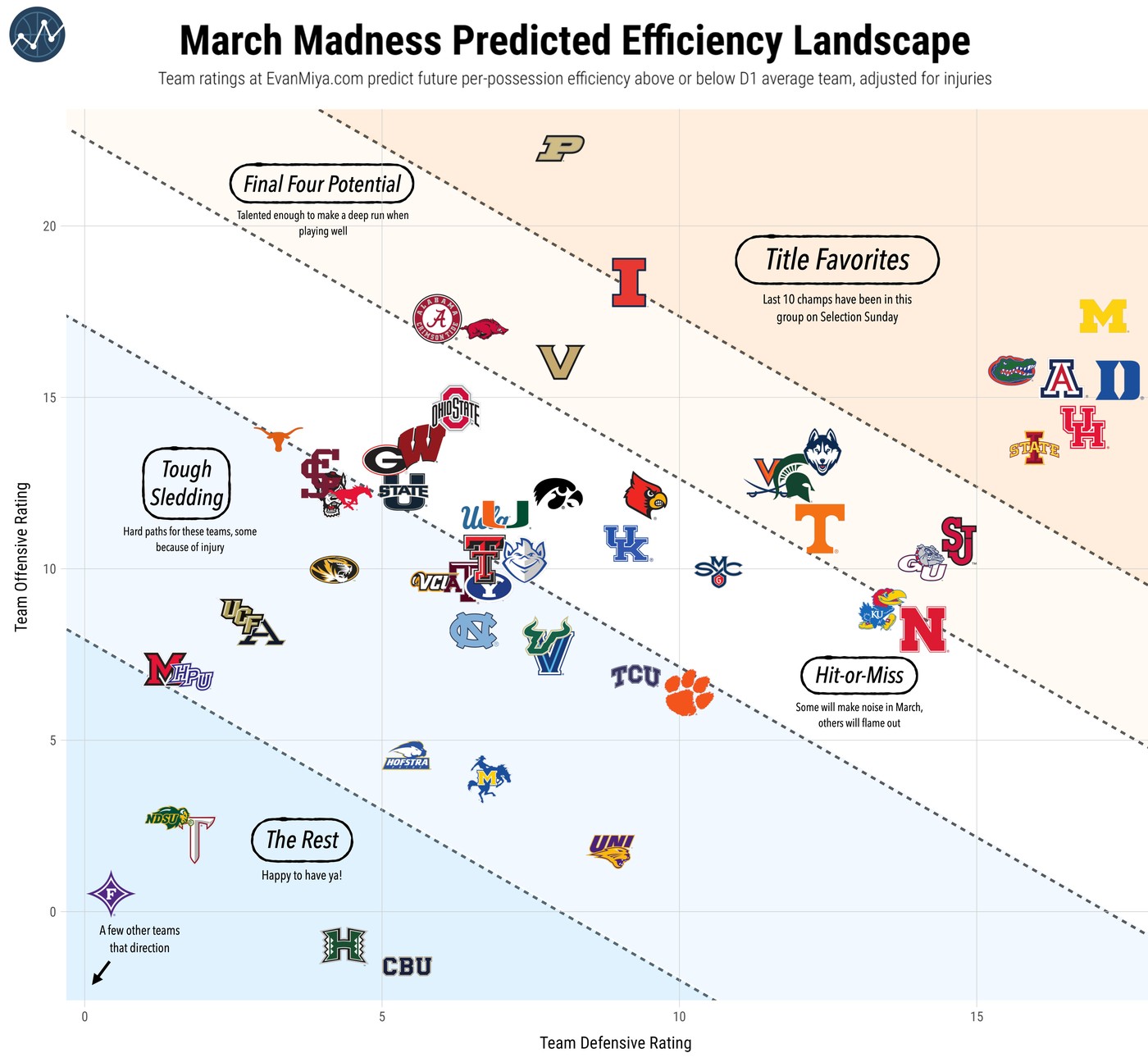
Lastly, this visualization was inspired by EvanMiya’s March Madness Efficiency Landscape graph which includes tiers of favoritism to win the NCAA tournament:
In accordance with him, let’s make our own bands of favoritism to win VCT tournaments based on this graph.
Another historical trend cited in NCAAM is the fact that every tournament winner in the 21st century has been in the Top 25 of KenPom’s rating system.
I have my own BenPom rating system for VCT - let’s see what the trend is there:
Note: LOCK//IN was not included, since there were ratings prior to the event
Every trophy winner since franchising was Top-15 by BenPom before the tournament70% were top-7
To go back to the point on teams that “overshot their previous domestic performance”, those teams often were playing better towards the end of their split. In other words, they had momentum. For instance, MIBR placed horribly on the Attack/Defense graph before Champions Paris, yet they finished 5th-6th at Paris and only lost to the top-3 teams at the tournament (narrowly). Importantly, in their Americas Stage 2 split, they won 2 of their last 3 games but were on a 5-match losing streak before that.
How important is momentum, then?
Note: LOCK//IN was not included, since there were no prior matches for any of those teams.
Interesting, only one team (Gen.G) was able to win a trophy despite losing a majority of their past 5 matches. Momentum is clearly important - half of the winners had a 4-1 record or better before their events. It’s also not the be-all-end-all, as 4 of the 10 winners lost 2 of their past 5 matches.
More generally, can momentum be a strong predictor of international success, not just winning?
Finished top 3Did not
The trend is there, but it’s nothing more extreme than we would’ve expected. Let’s move on!
One other trope that surrounds winners in practically all sports is the notion of star power. It’s an arbitrary concept, but the idea is that to win a tournament, you have to have an elite player who can rise in the most important matches/moments. In VCT, our best comprehensive statistic for player quality is VLR-rating, so let’s use that to look at each championship team’s best player in their previous domestic split:
Note: For EDG at Champions Seoul, I just used ACS since VLR rating wasn’t calculated in domestic CN splits until 2025
This is also extremely interesting. 1/3 of the winning teams had the highest-rated player in the previous domestic split. Also, T1 at Bangkok are again an exception to the rule. Their highest-rated player (Buzz) was ranked 18th in Pacific Kickoff 2025. The second-lowest rank in this list was 6th for RB with Nongshim in 2026. This article is just turning into “T1 winning Bangkok is a gigantic statistical and historical anomaly”, but I digress.
8/9 eligible tournament winners had a top-6 rated player in the previous domestic split7/9 had a top-4 rated player
Roster Composition
One trend I’ve noticed in trophy-winning VCT teams regards their rosters. More specifically, their roster turnover rate. Every single championship-winning roster made roster changes from the previous year OR they made roster changes during the year:
2023
LOCK//IN
FNATIC
(Preseason)
− Mistic− Enzo
+ Chronicle+ Leo
Masters Tokyo
FNATIC
(Preseason)
− Mistic− Enzo
+ Chronicle+ Leo
Champions LA
EG
(Preseason)
− Apoth− Reformed
+ BcJ+ Ethan
(Midseason)
− BcJ
+ Demon1
2024
Masters Madrid
Sentinels
(Preseason)
− Pancada− Marved
+ JohnQT+ Zellsis
Masters Shanghai
Gen.G
(Preseason)
− TS− k1Ng− eKo− GodDead
+ t3xture+ Munchkin+ Karon+ Lakia
Champions Seoul
EDG
(Midseason)
− Haodong
+ S1Mon
2025
Masters Bangkok
T1
(Preseason)
− Sayaplayer− Rossy− xccurate
+ Meteor+ BuZz+ Sylvan
Masters Toronto
PRX
(Midseason)
− mindfreak
+ PatMen
Champions Paris
NRG
(Preseason)
− crashies− Victor
+ Verno+ Mada
(Midseason)
− Verno− FNS
+ Brawk+ skuba
2026
Masters Santiago
NS RedForce
(Preseason)
− margaret− Persia
+ Rb+ Xross
Masters London
Leviatán
(Preseason)
− C0M− tex
+ spikeziN+ blowz
(Midseason)
− PxS
+ Neon
There’s a more interesting observation, though:
Every international-winning roster since Masters Tokyo (aside from T1 at Bangkok) has featured a rookie.Demon1 on EG, JohnQT on Sen, Karon on Gen.G, Simon on EDG, Patmen on PRX, Brawk/Skuba on NRG, Xross on NS, and blowz/Neon on LEV.
Oh look, another trend where T1 at Bangkok is an outlier!
Still, this speaks to the continuous influx of top-level talent into VCT. As years go on and Valorant has been around for longer, there exists a new generation of pros who grew up playing Valorant, the mechanical ceiling gets higher, and older talent generally fades out. It is proven that the best way to win a trophy in Valorant is by embracing new talent, not reshuffling older talent - even if it means adding newer talent into a roster with veterans.
This is bad news for a team that some would call the current Champions Shanghai favorites: NRG. Also PRX. We’ve watched both of these teams get outgunned by teams with a rookie/rookies in the two Masters events this year - by Nongshim at Masters Santiago and Leviatán at Masters London. I’m not necessarily advocating for making roster changes on PRX and NRG, I’m just pointing out a trend.
What’s even more damning is that every team that’s won Champions specifically has made a mid-season roster change to add a rookie. This is a low-sample-size observation, but I’m curious as to whether this trend continues at Champions Shanghai.
Note: This Champions trend implicates teams like Leviatán (RIP), LOUD, Vitality, and Fut
What about seeding coming into the event? This is a hot topic in VCT discourse, as there’s a common debate about whether the bye that first-seeds get in Masters events is a positive or negative. Let’s see what the trend is there:
Similarly to the momentum visualization, the trends here aren’t that surprising. It’s higher seeds that are winning trophies more than lower seeds, but that is a fairly lax rule. For instance:
There are an equal amount of #1 seeds and #2 seeds who have won.
Lowest-seeded teams have won Masters events 2/7 times (T1 at Bangkok + PRX at Toronto), though this is yet to happen at a Champions tournament.
Nothing much to note here.
Champions Shanghai
Now the obvious question: what can these historical trends tell us about Champions Shanghai?
This year’s Champions is, in my opinion, fairly open. The 1-seeds are not the teams people would’ve expected, thus they are “question marks” per se (e.g. GE, Tyloo, and KC). Meanwhile, plenty of the strongest teams of the year are coming into the tournament in poor form (e.g. Vitality, PRX, EDG). Or, in Leviatán’s case, they’re not coming to the tournament at all.
Given this open field, let’s apply the main findings of this historical overview:
70% of trophy winners were top-7 in BenPom before the tournament
All trophy winners were top-15 in BenPom
90% of trophy winners won a majority of their past 5 matches before the tournament
8/9 eligible tournament winners had a top-6 rated player in the previous domestic split
8/9 international winners since Masters Tokyo had a rookie on their team
There’s clearly one team that history smiles on more than the others:
100 Thieves
They’re the only team to meet 5/5 of the requirements coming into Champions Shanghai. In fact, they don’t just meet each requirement, they crush them. They’re #1 in BenPom, they have the #1-rated player from Americas Stage 2, and they have two rookies. Of course, this doesn’t mean a Champions win is a forgone conclusion, but it certainly helps their case.
For instance, look at how the past international winners since 2024 slot into this criteria:
A majority of international-winning teams hit 5/5, including the past 4 winners. Looks good for 100 Thieves!
The one part that I don’t like (i.e. find boring) is simply the fact that 100 Thieves are already the favorites to win Champions Shanghai.
Now, there are two other teams that history smiles on that I’d like to note:
LOUD
If I changed the “Top-6 rated player in previous split” requirement to “Top-7”, then LOUD would also meet 5/5 of the requirements. In this way, LOUD are far and away the second-favorites according to these historical trends.
Not for nothing, but I really like the case for LOUD to win Champions Shanghai. They have the momentum, youth, and certainly the star power (i.e. Erde and lukxo) that makes them dangerous and an exciting team to root for. What’s more is that they just played the current favorites (100T) to a Map 5 OT Bo5.
Karmine Corp
Now, there are plenty of teams with 4/5 historical trends met (e.g. Nongshim, Vitality, NRG, etc.) Why am I focusing on KC? Let’s go back to the Attack/Defense Favoritism graph from earlier and apply it to the Champions Shanghai teams:
Now you see why. KC are so, so close to being in the “Trophy Favorites” tier. Even if they aren’t exactly within that mythical level, they’re still placed the most impressively on this graph. Their domestic dominance is greater than any other team coming into Champions Shanghai, and that’s not something to take for granted. It should not be a surprise if they win the whole event.
How about a team that history frowns upon?
Paper Rex
Now, there are varying levels of depth with which we can talk about Paper Rex. In simplest terms:
They meet 2/5 the requirements, tied for the lowest out of every team at Champions Shanghai.
They’re middling on the Attack/Defense Favoritism graph, looking like one of the worst teams.
One of those requirements that they fail to meet is being 3/5+ in their past 5 matches, instead being 2/5. Those two wins were against… Onside Gaming and Team Secret. Yikes.
Even T1 at Bangkok, a historical anomaly, met 3/5 of the historical trends before they won their tournament.
Historically, they don’t look great. The counterargument against history is simple, though:
They qualified to Champions before Split 2 even started, so their stats could all look horrible because they weren’t trying in Split 2 and experimenting instead.
They’ve been to both of the past two international grand finals.
I’ll save completed team analyses for a later, full preview of Champions Shanghai, so stay tuned for that. Still, this was an extremely interesting reflection on VCT history and I hope you enjoyed reading it as much as I enjoyed writing it.
 FNATIC
 EG
EG Sentinels
 Gen.G
Gen.G EDG
EDG T1
T1 PRX
PRX NRG
NRG NS RedForce
 Leviatán
 100 Thieves
 LOUD
LOUD Karmine Corp